Usually, what we are really saying when we ask for writer’s block advice is: Get me out of this tension. Make me feel okay. We want the answerer to sprinkle magic block-busting dust over our brains and help us see the bright clear world on the other side.
Read MoreI feel a bit like Phil Connors in Groundhog Day when I write, “Happy New Year… Again.” And I’m suspiciously eyeing my blank 2026 calendar months, doubting they will indeed be anything different.
Read MoreI distinctly remember a conversation I had with my sister a couple years ago in which we shared what our public tells were for, essentially, having our creative practice on track. For her, it was sharing new illustrations, which she’d lamented not being able to do more regularly due to a busy work schedule. For me, it was posting on this blog. I remember saying: “if you don’t see a Wild Minds post for months, that means I have completely lost control of my time and schedule.”
Read MoreOn Sunday afternoon, I lugged my suitcase back into my house after two glorious weeks in Scotland and England. Two weeks was the perfect amount of time to go away—long enough to really get away and fully enjoy the trip, and also long enough to become tired from 22,000-step days and spending 24/7 with other people (I love these fantastic people dearly, but I’m an introvert with a small social battery). It felt great to be back home with my cuddly cat, ready to luxuriate in my own personal space.
At least, until Monday arrived.
Read MoreThere’s a saying I’ve heard many times in my writing career journey, both in terms of the stories we write and the relationships we build: “People don’t remember what happened; they remember how it made them feel.” This is true of events too. Austin Film Festival is jam-packed with amazing people, brilliant minds, and incredible projects.
Read MoreAll year, industry screenwriters have shared their accounts of not being properly compensated for vital contributions to an industry that makes an absurd amount of money off their ideas. Many writers and other artists are having existential crises. It feels like we’ll never be respected or rewarded for creating things, so why bother?
Read MoreNo matter the format or the genre, rejection is almost always due to one of a few common missteps. I want to share them so that we can all put our best writerly feet forward—because I, too, am a writer who submits my work to the mysterious realm of Readers who I hope will take my work seriously and consider it for a next step. First, some good news: readers are hoping to be enthusiastic about your work.
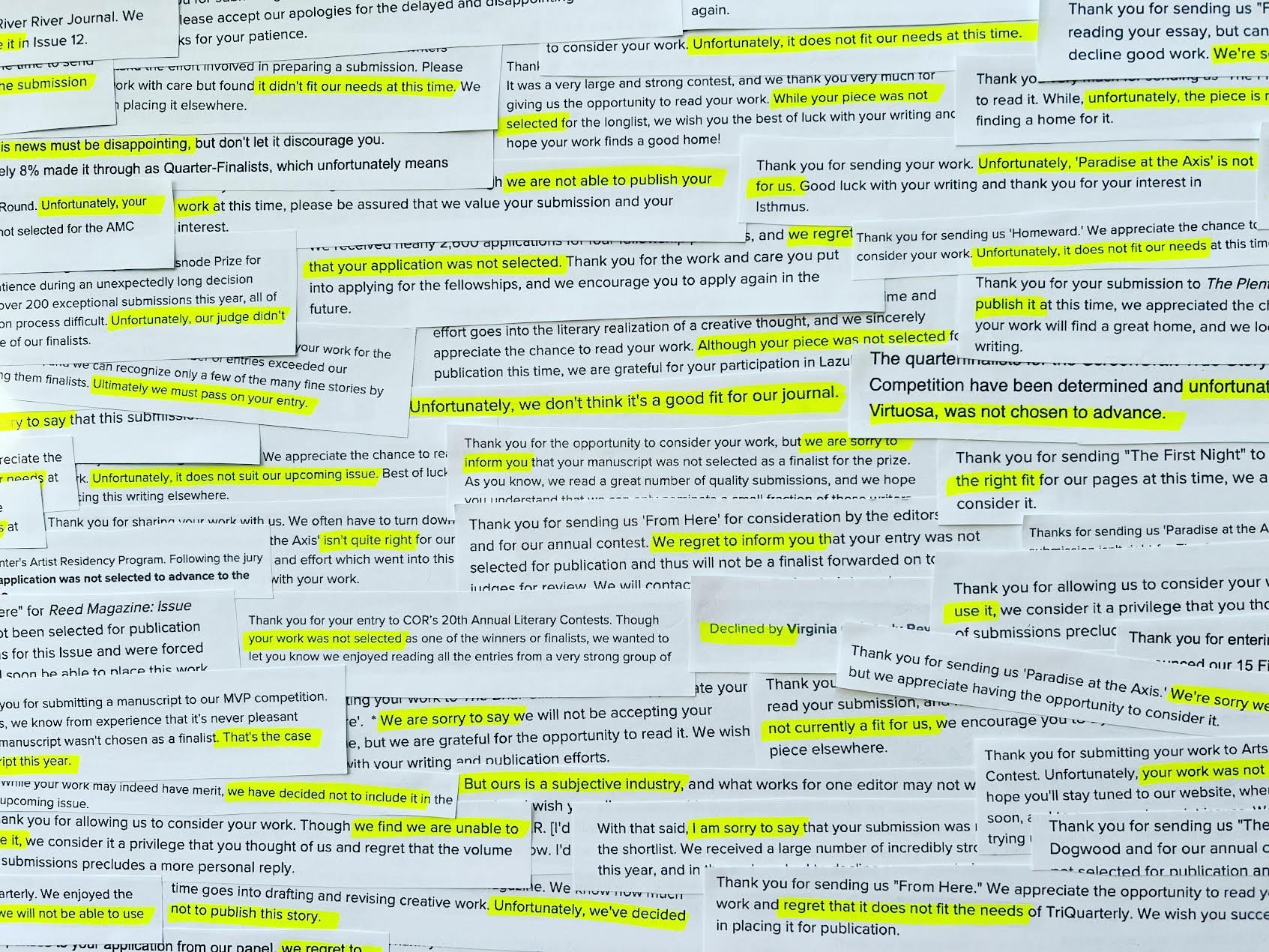
Read MoreI made a rejections collage. Yes, a real-life collage—the kind of collage you buy a poster board and glue sticks for—of my rejections. Not all of my rejections, but the ones that were easiest for me to find through my Submittable account and old emails. I wanted to write about rejection, and it felt important that I spend quality time with my rejections in order to do so.
Read MoreI’ve always had a physical journal to write in, and most of my non-journal writing projects still begin on a sheet of paper. This process feels sacred to me. Writing by hand feels more like I’m connecting with the “earth” of creating—making something in messy, slow, real life. It feels special.
Read More“Writing is rewriting” gives off a lot of that “practice makes perfect” energy, doesn’t it? It implies that you have to actually, you know, work and struggle. I like writing because in writing I don’t “have to rebuild all the time” in the way I have to do as a musician. But most expert writers seem to agree this is the real work of it all.
Read More