
The Three Big Q's, #1: How Do You Deal with Writer's Block?
Hello, fellow Wild Mind! Welcome to my lil’ summer series of posts, The Three Big Q’s.
I live two creative lives. One is the life of grappling: practicing, striving, struggling, progressing, hoping, failing, re-starting. The work of creativity.
The other is the life of instruction: piano lessons, writing classes, supporting clients and students in becoming more authentic, productive and empowered artists. The teaching of creativity.
One reason I love to teach is that it forces me to clarify my thoughts in a way I would never have to do if I weren’t explaining it to someone else. Teachers are supposed to have expertise. But in the creative world, at least beyond the nuts-and-bolts type of knowledge, it’s quite rare to feel like an expert in your own work. Because with every new project, you have to start all over again.
Rather than being expertly in control of my writing, I usually feel more like I’m struggling to find the right steps to the dance my project is already dancing in some place I can’t really see, and I’m always behind and trying to catch up.
“What is wrong with you?” the faint voice of my project calls out from the blurry distance I cannot reach. “Why haven’t you just figured this dance out yet?! I’m right here!”
Then I scratch my head and think, “Huh, and I am supposed to teach the dance now?”
All this to say: I grapple with the same questions that students and clients ask me. And there are three in particular that I hear more than any others, so I thought I’d tackle them in this series of posts, as much for myself as for you.
Without further ado:
How do you deal with writer’s block?
While questions #2 and #3 (stay tuned!) are asked by piano students and writers alike, this question is pretty stuck (har, har) in the writerly domain. That’s because pianists don’t really have much excuse: the music is right in front of you. The practice requires physical discipline not unlike a sport. You sit on the bench and work on what you need to work on. Not that you can’t feel blocked as a pianist (and of course, it’s not only a physical practice), but you pretty much always know what your next step is and you just need to take it. When piano students haven’t practiced for their lesson, they tell me about the busy week they had or the illness they suffered. They never say, “I was just blocked.” (Or the truth: “I just didn’t.”)
But writers sometimes have absolutely no idea what to do when we sit in a chair and face the page, and the lack of a physically specific task can make it feel impossible to center ourselves here on Earth.
Usually, what we are really saying when we ask for writer’s block advice is: Get me out of this tension. Make me feel okay.
We want the answerer to sprinkle magic block-busting dust over our brains and help us see the bright clear world on the other side. Since I can’t do that for myself let alone for anyone else, let’s dive into the different things this writer’s-block question could really be referring to:
“I can’t think of any ideas.”
“I can’t figure out what comes next.”
“I can’t stop procrastinating.”
“I can’t come up with a solution to a problem.”
“I am experiencing a highly specific and dramatic existential crisis and I am not any good at anything at all and if someone doesn’t talk me off the ledge right now I will cry for a week and quit this forever.”
These are all unique experiences, but, at least for me, #s 1-4 are really just little building blocks to #5, which is my true Writer’s Megablock that I suffer through at least once a week (my dear, patient spouse can confirm).
But let’s break the smaller ones down first. If your writer’s block is #1-3, you have a bump, not a block. And it’s a bump of your own making. Your key phrase is “I can’t,” and the answer to that is, “You can.” You can totally think of ideas (because ideas don’t even require actual thinking!), you can definitely figure out what comes next (because you’re the person in charge, silly!), and you can absolutely stop procrastinating (but you already knew that and you only asked the question to procrastinate more!).
So, maybe the real question is: what can you do to stop holding yourself back? (Note: we don’t need to answer why you’re holding yourself back. That answer is fear. I’m sorry to say it’s nothing special.)
For #1: Instead of, “I can’t think of any ideas,” try, “I’m now going to write down new ideas.”
Wonderful! This is as easy as taking out a pen and a napkin and writing 10 ideas. There is no good or bad, only baby ideas that haven’t developed one way or the other yet. How fun! Example: In writing new episodes for my web series, I felt so stuck on where the next episode should take place that I couldn’t write one word of it (this is an example of producer-brain blocking creator-brain). But writing a long list of possibilities freed me up to start feeling it out. I might not have had an answer right away, but “I can’t think of any ideas” was no longer the problem. Which got me a little closer to where I needed to go. And getting a little closer is all we’re trying to do.
For #2: Instead of, “I can’t figure out what comes next,” try, “I’m now going to explore what comes next,” followed by everything I wrote for #1.
But this time it should be a little easier, because you already have a place you’re hopping from instead of creating on a canvas of overwhelming possibility. Enjoy!
For #3: Instead of, “I can’t stop procrastinating,” try, “I’m done procrastinating now.”
That’s right, be a person of action! A creative with initiative! Take an action, any action that serves the purpose you’ve been avoiding, and you’re done procrastinating. As a still-struggling perfectionist, procrastination is a bigger part of my daily life than I’m comfortable admitting. What often helps me is setting a 15-minute timer to focus on my work. 15 minutes sounds so short, like it will be over pretty soon, so it makes me feel like it’s no big deal, and I focus as soon as the timer starts because I have to. (I love an assignment!) Once I do this, I always end up working longer than 15 minutes. This is because I always find the flow of my work at exactly minute 14-and-a-half. But even if I did stop at 15 minutes, hey, that’s 15 minutes of work! At the very least, it’s a little bit of chiseling in the right direction. And if you’re lucky, it might feel like more than that. But you can’t be lucky if you’re not trying.
Another important piece of advice: get off That Phone. Put a lot of physical distance, preferably a room or two, between you and That Phone. But you already knew that, too.
To summarize: #s 1-3 are completely within your realm of capability. You just have to do them. I’m sorry! But you just do. And you can. So that’s the great news: you actually don’t have writer’s block! Congratulations! How prolific and creative you get to be now! Consider this your clean bill of creative health.
When things actually get difficult
Unlike the first three issues, #4, unfortunately, can be a bona fide tracks-stopper. “I can’t come up with a solution to a problem” might really mean “I can’t come up with a solution to a problem.”
Shoot!
First: take heart! Welcome to being a real writer. This kind of block means you’re about to grow as an artist, because we get stronger when we struggle against our limitations. Listen to the Rocky theme or do some jumping jacks because it’s time for you to Try. Your. Best.
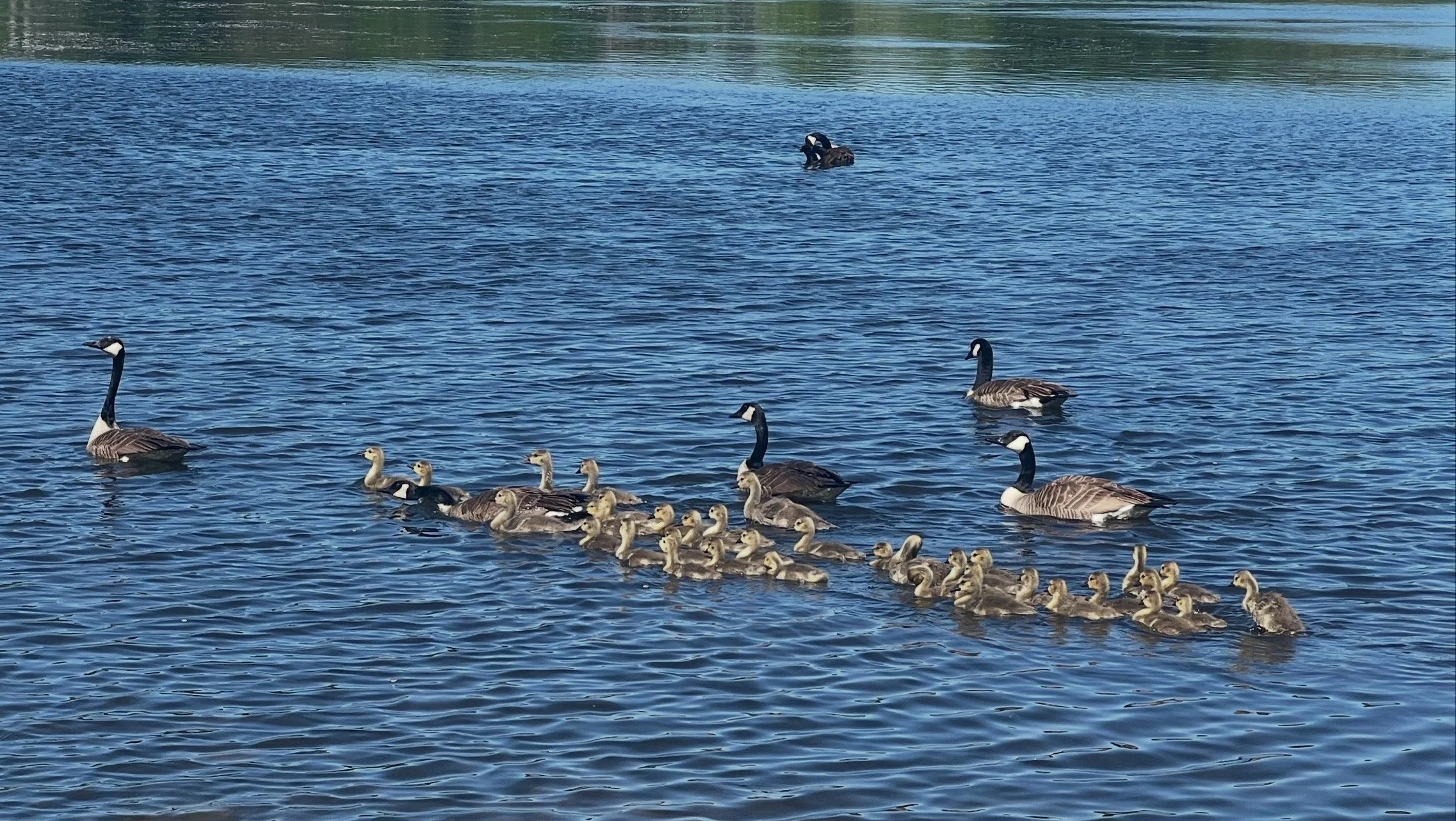
Taking a break and going outside might lead you to stumble upon the stunning sight of a giant family of goslings, which just might make you feel a little more grounded in your soul.
Second: don’t panic! The great outdoors exists for a reason. Other art exists for a reason. The writing community exists for a reason. And that reason is: you are not alone. If your writer’s block is a #4 situation, I recommend trying one or all of these. You might need to take a break. Stop thinking about it, let it be, get outside and inhale the smell of the trees. And if that doesn’t invite a natural cure, fill your creative cup with projects that might be adjacent to yours. I re-watched Big Little Lies and Mare of Easttown to help me re-outline my drama pilot. I used to listen to recordings by other pianists to better understand what I most wanted to express in a piece of music.
If you’re still stumped, get some other brains involved. Phone a friend, take the problem to a writer’s group, ask a mentor when you can buy them coffee and talk it through. What a wonderful way to organically connect with your community and let people into your process. Don’t have a writer’s group or a mentor? Amazing, now you know your next step, which is to find one. All we ever need to do is identify and take one next step.
See, other people have this great advantage of not being you. They’ll see the problem in a way you aren’t even capable of. Unfair, sure, but so cool! You might not get The One Single Perfect Answer out of this, but you will get a fresh take or two. You might get some wrong ideas that help you get a little closer to what would feel like a right idea. And, hey, maybe you’ll get an idea that leads to another idea that feels good, or that even just feels Good Enough For Now.
If this is a real Block with a capital B, Good Enough For Now can do wonders. Good Enough For Now means we can keep moving. Maybe that scene in Act II isn’t gelling yet, but look, we are now able to work on Act III! Incredible! Are we still going to be dealing with that problem section at a later date? Probably, yeah, which is why we want to do our best with it now instead of ignoring the issue. But I say whatever keeps you moving is worth doing, and it might be the work you do next that helps you discover what the answer is. Life’s too short to get too stuck.
Writer’s Megablock (!!!!!!!!!)
Issue #5 can attack us if any or all of the other 4 aren’t dealt with in a timely, capable and mature manner (I know, what a drag). It’s a pretty clear-cut sentiment: “I am experiencing a highly specific and dramatic existential crisis and I am not any good at this at all and if someone doesn’t talk me off the ledge right now I will cry for a week and quit this forever.”
This is not really an “I can’t” statement. This is an “I don’t believe” statement lethally combined with an “I am terrified” statement and you are, as they say, spiraling. This is not really about anything you can do on the page, but is more about how you take care of yourself.
And, so, hear me out, this one means you need to take care of yourself.
First, you need to completely forget about writing. I’m not kidding. I’m not saying it in a trick-the-mind way. Like, really stop thinking about it. Who cares about it? Not you! Let’s write because it expands our lives, not live our lives to serve our writing, you know? Life is the important thing.
So, let’s take a beat and tend to our existence. (And if you’re writing not necessarily to expand your life at this moment, but because it’s paid work with pressure and a deadline, I still recommend this. You can set the responsibility down; it will be there to pick up later. You can’t write the thing that’s stressing you out in this state, let alone write well, so relinquishing control is the only way forward. I know, what?!)
If you’re having a meltdown, you get 10 minutes to have it. Vent it, feel it, cry it, take it out on a punching bag, whatever you need to do to let it leave your body and be in the world where you can see it and recognize it as your Megablock (notably something that is not you; something whose entire purpose is to make you feel horrible). But only for 10 minutes. Will you have your feelings out in 10 minutes? Probably not. Will you feel like you want more than 10 minutes and that setting this time limit on your raw emotional state is super dumb and annoying? Undoubtedly. But after 10 minutes, do these things and then you can get back to wallowing in your emotions if you want to:
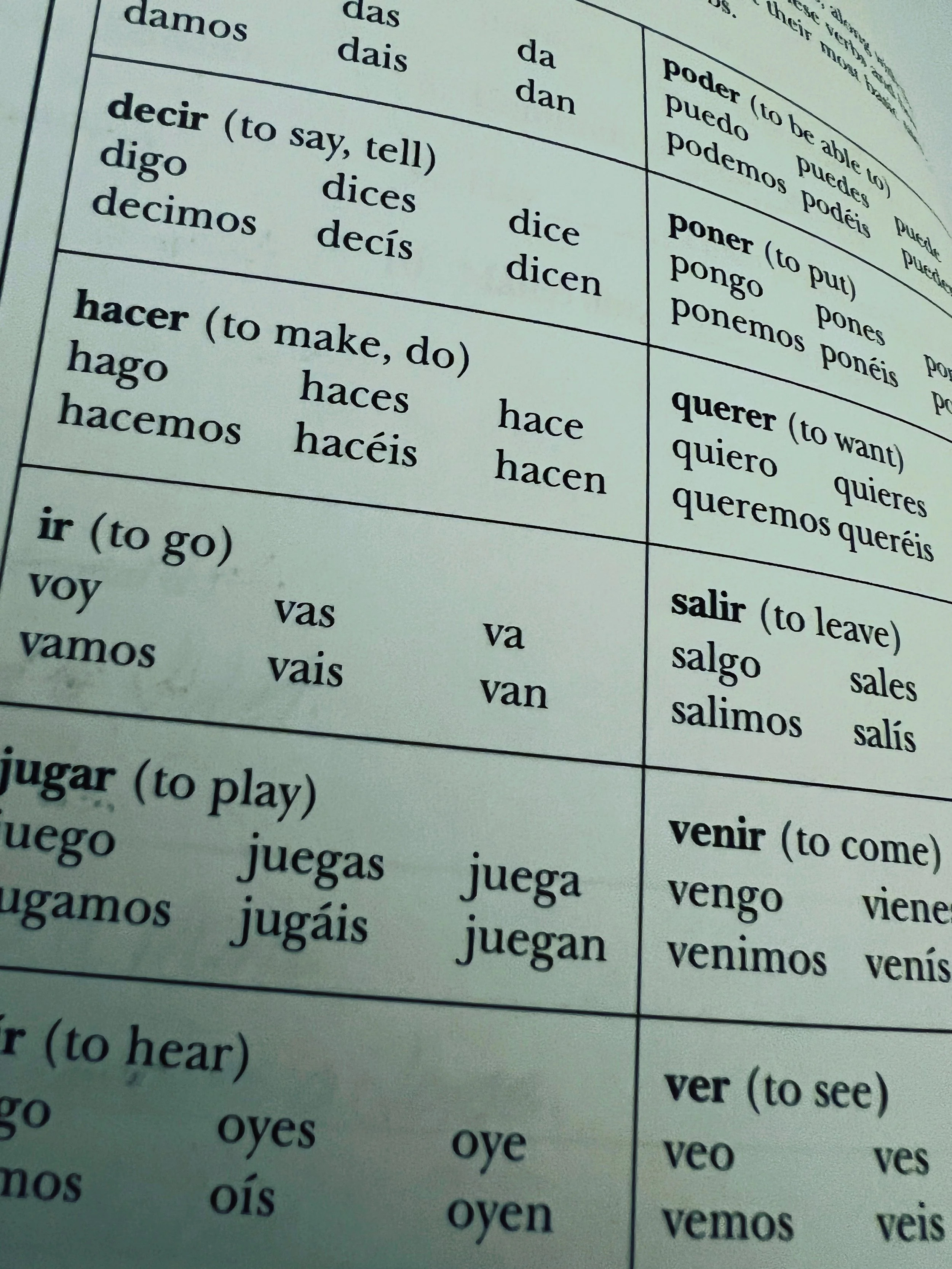
There is just no way to focus on a creative block when you are trying to memorize juego, jugamos, juegas, jugáis, juega, y juegan. (Or whatever language is foreign for you.) Plus, it like, feels a little bit productive? Which is something close to the feeling we’re craving.
Drink a really large glass of ice water. Ice because it makes it feel fresher and you deserve to feel refreshed. Large because you need to drink so much water, I just know it. Maybe add a squeeze of lemon because you deserve that too. Then, fill the glass up with water again and you can sip the next glassful more gradually.
Eat. A meal, a snack, whatever makes sense for you in this moment, but it should be something nourishing and filling and not gross. If this means taking time you don’t feel like you have to prepare food, do that (you can sip your lemon water as you go! Look at you, rocking at life like someone in a movie!).
Sleep. At least 30 minutes, but maybe an 8+-hour night of sleep depending on where in your day this list finds you. But just sleep. Turn it all off. Rest. If you can’t sleep cuz #anxiety, get out your foreign language textbook from high school and start reviewing irregular verbs until you can sleep. (Or, like, any other kind of focused activity that engages your brain away from the parts that feel anxious and terrible.)
Exercise. I know it is sooo annoying that exercise makes our brains feel better, but it does. So do a little bit of it. At least 20 minutes. This could be a brisk walk but I’d encourage dialing it up to a run. It could be an easy yoga session but I’d encourage the kind that requires physical stamina. Work your body a bit. Say hello to endorphins. You like them, remember?!
(Plus, when you find the edges of your physical limits and work the literal muscles there, your brain might feel a little more empowered to hang out in the spaces where your limits live instead of being afraid of them. See, now we’re getting a little sneaky.)
The goal with these disturbingly basic reminders of self-care is to loosen your grip on your poor tired brain and help your self get closer to feeling like yourself again.
After those four things, you are totally welcome to keep wallowing if that is what you desire (and hey, maybe you do just need it for a while; that’s not for me to judge!).
But sooner or later, if not right now, you might find yourself relaxing into the knowledge that the only way forward is to move a little bit forward, and that you are fully capable of that (see #s 1-4).
So, what could a next step be? Any next step. Start there.

Flowers don’t think; they just open toward the light.
The latest episode of author/illustrator Andy J. Pizza’s Creative Pep Talk podcast is about this very topic. “Creative block isn’t a thing,” he says. “It’s many things.”
Brilliant Pixar story mind Pete Docter is quoted in Ed Catmull’s book Creativity Inc.: “I tend to flood and freeze up if I’m feeling overwhelmed. When this happens, it’s usually because I feel like the world is crashing down and all is lost. One trick I’ve learned is to force myself to make a list of what’s actually wrong. Usually, soon into making the list, I find I can group most of the issues into two or three larger all-encompassing problems.”
I recently experienced a Sundance Collab session I’ll never forget with Kim Gillingham, the founder of Creative Dreamwork (and the Dream Consultant on Hamnet!), which is about engaging creatively with the unconscious. She taught that our thinking mind is not meant to come up with answers, only questions. And “any tending to the soul nourishes the will.” (Brb while I quick get a tattoo of that.)