
The Three Big Q's, #2: Do You Write Every Day?
I started my previous post, written in June, by saying I would write 3 posts this summer, dedicated to the 3 most common questions I get asked as a writing instructor and coach. This is the second of those posts. You’ll need to join me in not accepting that it’s September already, because why does time move like this?
Practice Math
When I was a classical pianist, it was always clear to me how much I was supposed to practice, though different teachers had their own rules and equations. Take, for instance, the “9-9-6-9-9-6-0” rule. That’s 9 hours of practice a day for 2 days, then a 6-hour day, then repeat, then you get a zero day, and that’s your practice week. As one kind teacher affirmed, “You need a day to do your laundry.”
Not every teacher advocated for the zero day. One teacher answered the “How much should I practice?” question with a deadly serious, “As much as you can.” Another taught that for each day you miss of practice, it takes 2 days to catch up to where you were before. Taking a 3-day-weekend vacation? Great, now you’re over a week behind because not only have you lost 3 days to your break, but it’s going to take you 6 more just to catch up.
“Catching up” was a big part of how practicing piano felt to me for probably about 15 years. I almost always felt behind, always had more to do, was always aware of the parallel-universe “better” version of myself and how much further along she was than I was.
This might not sound like the healthiest way to feel every day, but I actually experienced it as a motivating, even exciting, force. There’s something satisfying about always knowing you have a next step to take and what that step is. And the work really did require this kind of time commitment. I was a classical pianist working to become a better classical pianist. Depending on the era, I’d be preparing for regional or national competitions, solo recitals with 2+ hours of repertoire, auditions for some of the best music schools in the world. So, yes, I was putting in long hours at the piano. The “How do you get to Carnegie Hall?” joke is no joke.
More importantly, at the core of this goal, was my deeper artistic desire — instilled in me from a young age by my teacher and the night I fell in love with Beethoven on my blue Walkman — to be the greatest pianist that I could be. I wanted to hone my technique, strive for excellence, identify my struggles and discover my limitations and push through them — all to serve the purpose of expressing beautiful music, and sharing that music with listeners who would be touched by it.
Non-musician friends and family typically thought this kind of time commitment was unusual at best, toxic at worst. During a period of time when I was indeed practicing 9 hours a day for a big competition, I knew this number sounded insane to some (all?) people in my life. What do you even do for 9 hours? But 9 hours wasn’t even enough time to cover all of my repertoire. There was always more to practice that I didn’t have time to get to, always more work to do than I had energy for. Being devoted to an art form is to become acutely aware of your limitations as a human. But spending time in the spaces where these limitations exist and facing them head-on has always felt, to me, like a kind of intoxicating elation. There is no better feeling than when I know I’ve made the tiniest bit of progress in that hard place; that I’ve changed myself.
I wasn’t the only practice nerd in music school with this attitude, of course. We were all striving for our own versions of greatness, which was an exciting milieu to be working in. One of my friends at NYU (this one, in fact!) once put a sign on his practice room door: “DO NOT INTERRUPT UNLESS THERE IS A FIRE, AND ONLY IF IT IS A REALLY REALLY BIG FIRE!!!”
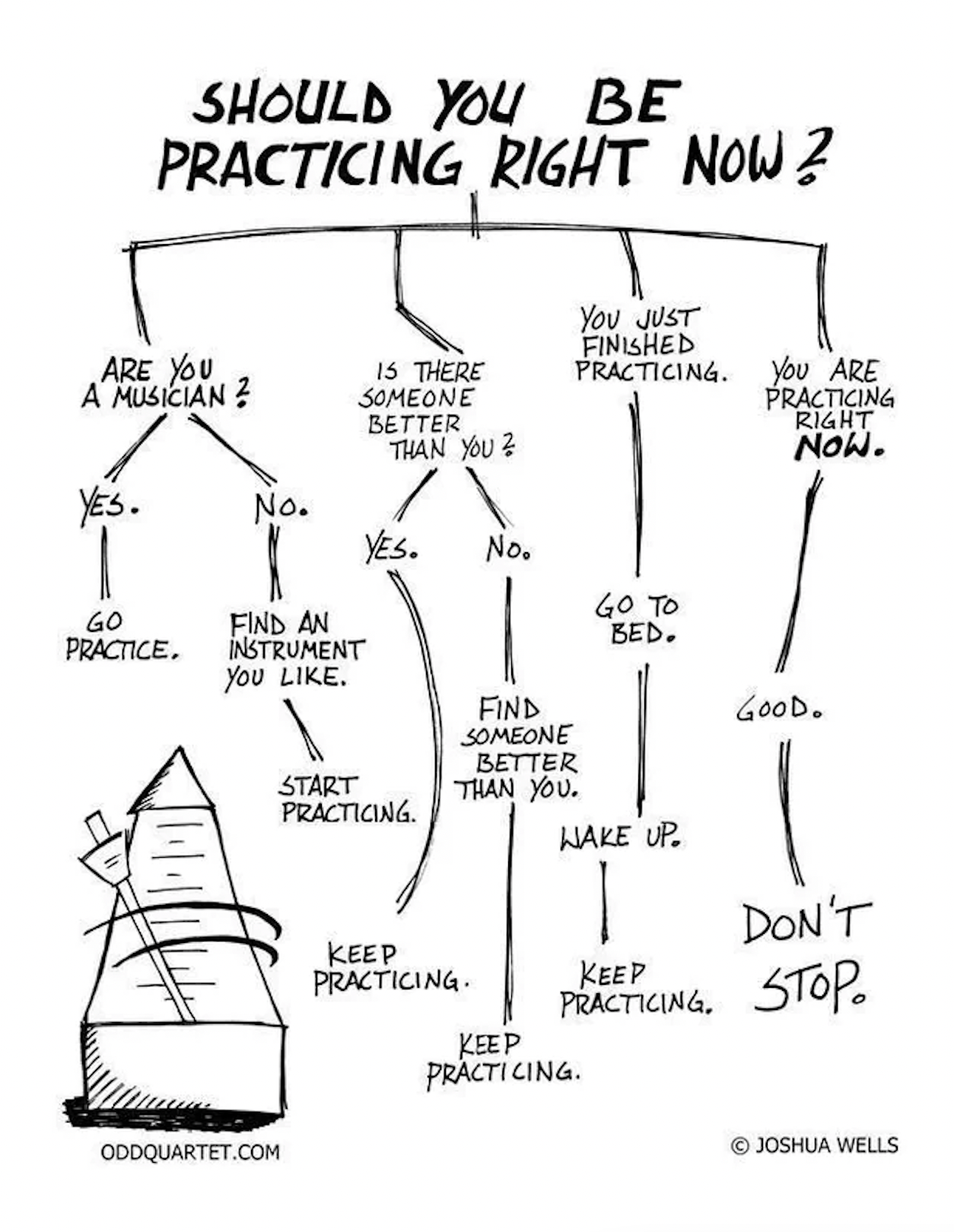
And just about every music student I knew delighted in memes like this one:
Tempting Saturdays
It probably won’t surprise you to learn that this approach became, for me, a constant pressure to be practicing piano — to fill every open space in the day or night with the keys under my fingers or the score before my eyes. But this pressure was so familiar to me that I’d never identified it as “pressure.” We don’t always notice the things that are as familiar to ourselves as ourselves, and a certain level of intensity was simply part of the ambitiously creative life I was into. (I kind of admire my younger self for this — like, she knew it was tough, but so what? <3)
I did my master’s in music also at NYU, and every Saturday morning during this time, I’d take the L from my apartment in Brooklyn to the East Village. I’d walk the few blocks to the practice rooms with my backpack full of classical music scores and snacks for a full Saturday of piano time. I was the literal image of the dream I’d had for myself since I was a preteen musician in Minnesota.
But on one of these lovely mornings, I suddenly stopped in the middle of 2nd Avenue with the halting feeling of, “I really do not want to do this right now.”
I’d had a fun hang with a good friend the night before — the kind of hang that takes you out of your everyday life for a beat and makes you remember you’re human — and I just wanted to spend my day living in that feeling and doing absolutely nothing that was required of me.
I panicked, my heart pounding as I froze in the middle of New York’s forceful flow of pedestrians. Because I’d never encountered this conflict in such a stark way before:
I have to practice. AND: I don’t want to practice.
I didn’t know which sentence had more authority, but my body chose for me. I turned around and walked back to the subway station. I burned so much with the feeling of committing a sin that I still remember this seemingly ordinary moment well enough to be writing about it here, more than 10 years later.
But I also remember a different kind of Saturday in New York from the same time period. It was a sunny spring day. Colorful tulips were blooming in the West Village, where I’d just finished teaching a funny 7-year-old girl who only ever wanted to play the ‘Jaws’ theme. I was on my way back to campus and had a practice room reserved for the day. A new Steinway, but a windowless basement room. Fluorescent lighting. Blech.
It was so pretty outside. It was New York City. People with coffees! Saturday! The gorgeous tulips! I live here!!!
The natural thought crossed my mind: I could just not practice. But a second thought came, one that held the first in its strong, loving arms: How lucky am I that the world is this beautiful outside and I get to spend an entire day communing with some of the most brilliant music ever written?
I got myself an iced dirty chai and purposefully chose a day in the basement, with no regrets.
Practice Questions
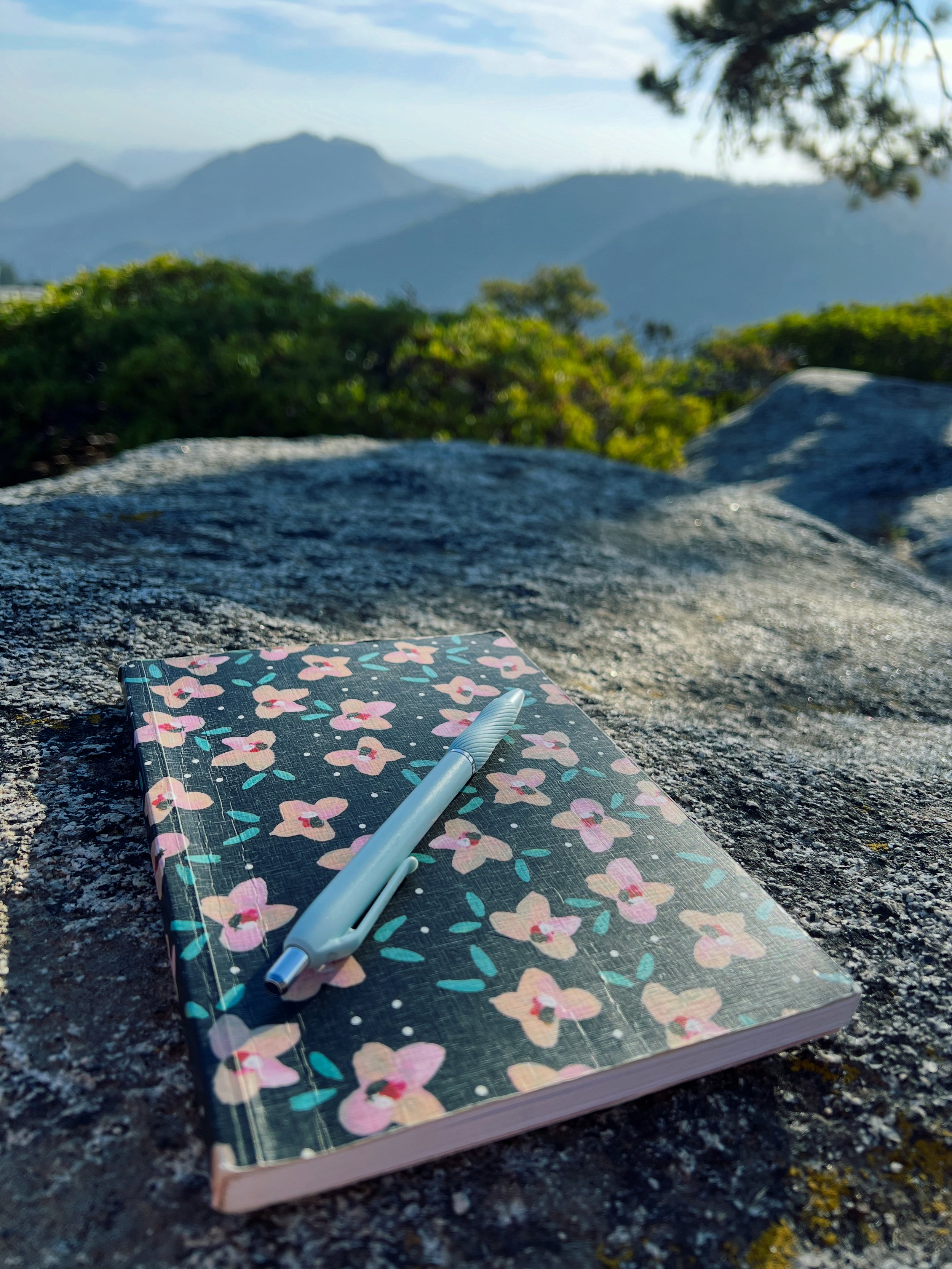
It can be easy to write if you’re in a beautiful place.
I share these examples because this was a period in my creative life when I was learning how to listen to myself. And whenever a student or client asks me if I write every day (i.e. would I prescribe that they write every day), these are the memories that come surging into my brain in a big cloudy conflict that makes it hard for me to see clearly.
Because I believe two things are true:
If you want to be really good at something, you have to put consistent work in, even when you don’t feel like it (sometimes, especially when you don’t feel like it).
Forcing yourself to do something you don’t want to do is bad. Bad for the art, bad for you, bad for the people around you.
I think what every artist needs to get really good at is understanding where their line is between, “Do I want to do this on a deep-down level even if I really don’t feel like it right now and/or I’d rather be doing anything else and/or it makes me want to pull all my hair out?” and “I fundamentally do not want to do this.” Because if you fundamentally don’t want to do something, don’t. But if it’s just that it’s hard, well… welcome!
When I stopped performing to focus on writing nearly eight years ago, it was an opportunity to examine my relationship to practice (hence this whole blog). I love the comforting idea of routine, and I was excited about the prospect of finally bringing my good friend Discipline over to the writing life with me.
At the same time: I was freakin’ tired. I’d felt a lovely sense of freedom when I decided I wasn’t going to practice or perform again any time soon, and I didn’t want to give that up. Plus, writing felt harder than practicing piano. I didn’t always know what the next right step was, and everything had to come out of my brain (no more working through what a composer had already brilliantly created), and I cared more about it so the stakes felt higher.
Alas, the reality of daily life answered this write-or-rest debate for me. Since I’d started this endeavor in a different time of life (no longer a student), all I could really do was squeeze the writing in wherever it fit (because as a real-life grown-up there’s this whole thing about how, like, you have to pay bills and take care of your home and whatever). Some days, it just didn’t fit, or the energy just felt impossible to scrape together on top of a long piano teaching day. And I was tired of pushing myself past my energetic limits. I wasn’t trying to get to Carnegie Hall anymore, so I was going to enjoy my coach-potato time when I wanted it, thank you very much.
But throughout it all, I desperately wanted to be a writer who writes every day. This seemed like the objectively correct answer to the debate, and I like to do things correctly. I kept thinking, Well, maybe I’m just in an adjustment period. Maybe I’m recovering from being a pianist. Maybe when I’m ready, I’ll write every day.
So, when I went on my first writing residency earlier this year, I thought my two luxurious weeks of writing time were going to provide the perfect container for the perfect daily writing routine. As it turned out, “container” was the opposite of what my residency felt like. My residency felt boundless. For the first time in my life, my creative process could show me what it was, instead of me having to shove it into whatever time slots I could give it.
Instead of a “routine,” I found myself doing whatever I felt like in the moment, which varied wildly. I worked on a script for 10 hours one day and then zero minutes the next day. I found myself writing completely new essay material that I hadn’t planned on because it just felt nice to keep exploring a theme in a notebook with no end goal or end time. One day I drove around and blasted Patti Smith, then stayed up late revising an outline. One day I worked on a puzzle and watched Veep episodes in bed and did nothing else for hours, and it felt amazing.
I learned that my writing life might not move the way my piano life moved. I think my writing life has seasons (and some seasons are Write Every Day seasons), and my writing process has its own mysterious waves and cycles. And, I think, it might be impossible to remove my writing practice life from the intense piano practice life that preceded it. In some ways, my writing life demands to be different from what came before it. It wants to be a little unwieldy, a little stubborn, a little freer and harder to pin down. It doesn’t exist in a vacuum. It exists as a response to something, and it likes when I respond to it.
To Write [Every Day] or Not to Write [Every Day]?
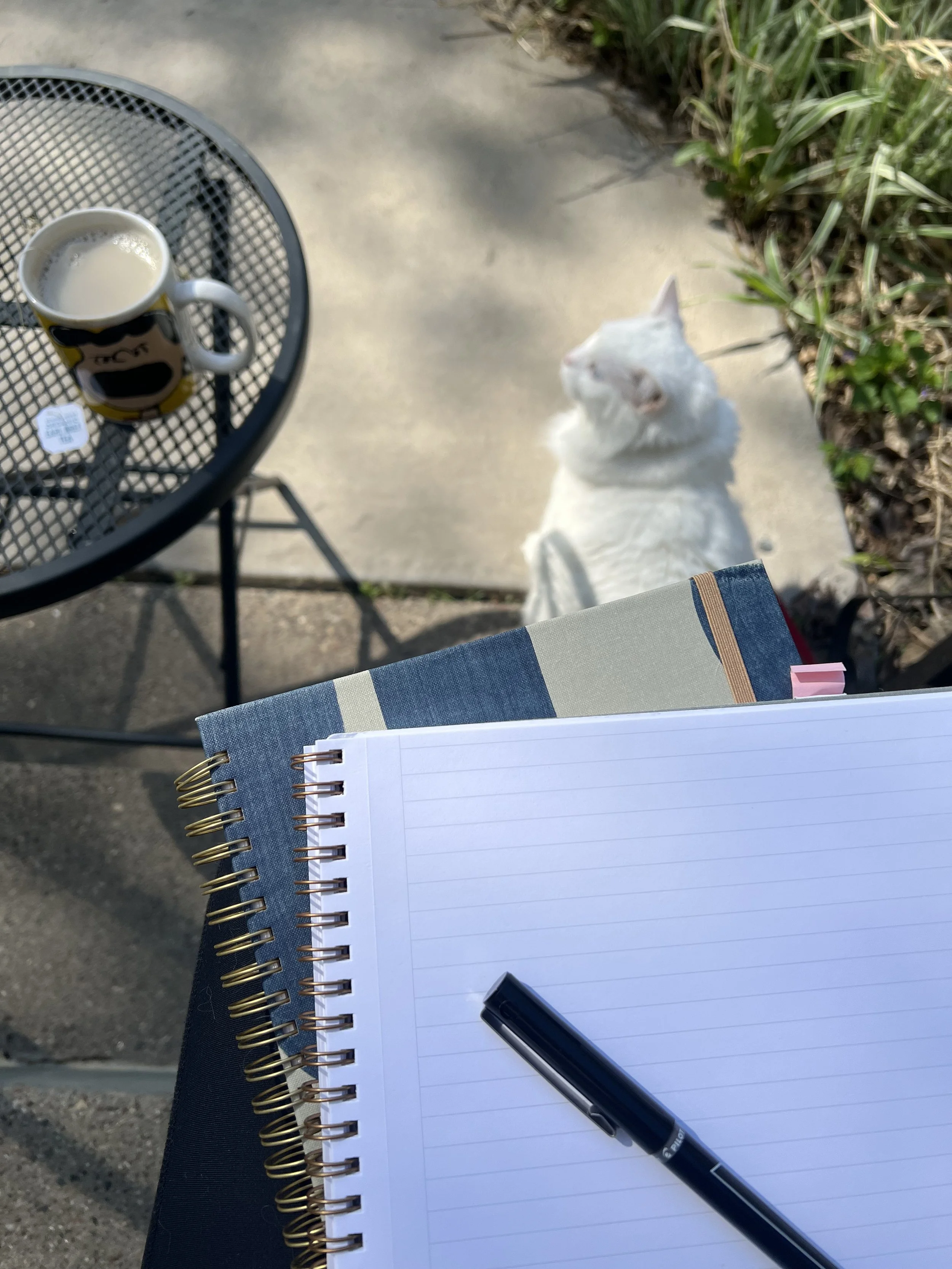
It can be difficult to write if you have a very cute cat.
To be clear, there are a billion good reasons why a writer should write every day. I agree with Roxane Gay’s teaching that writing is a muscle that needs to be regularly exercised. I agree with Octavia Butler that “habit is more dependable than inspiration.” In my podcast writing work, I’ve had quick deadlines that required me to write and rewrite fast. To be a TV writer, you need be comfortable coming up with quick ideas and working long hours on story. If you’re writing a memoir or a novel, you need stamina. These are all skills that require practice. If you want to be great at something, there is no way around practice.
This is why I do feel, in an ideal world, yes, of course we must write every day. That’s how writing happens. That’s what writing is.
But, I kind of think rather than asking, “Should I be writing every day?” it’s more important to consider something along the lines of, “Am I living a life of wonder and observation and taking care of myself today?”
Because I’m coming to understand that writing is really the byproduct of living my life with intention. Writing is what I naturally come to whenever I’m feeling most true to myself and most awake to the world, whether that’s in good times or bad times.
I hope, then, to feel as true and as awake as possible each day. And I trust that if I’m in that space, writing has an easy time finding me.
How does your writing most easily find you? Because, spsst, despite all the very good advice out there, you are the only person who knows.
If you are indeed seeking a boost of Write Every Day motivation, I recommend following Jami Attenberg’s Substack. This is the home of #1000wordsofsummer, a challenge to write 1000 words per day.
Some don’t-write-every-day practical advice from Allison K Williams, if you’re a fellow “binge writer.”